Sunday, 23 March 2008

Hardcore Management Meets Joseph Campbell

Every so often there will appear a strange symmetry to the books and articles that I read. One such parallel which I found when reading Jo Owen and Joseph Campbell on the same day appears below.

I have encountered many other quotes which cover a very similar ground - but since both of these appeared at the same time and at a relevant moment I thought I'd include them here.

Business should stop playing to each other people's rules. following competition means we will never catch them. Adopting fads and seeking excellence provide the solution to someone else's problem. The challenge for management is to compete by playing a game where they make the rules. To do this is not about seeking instant answers: it is about knowing the right questions to ask about the customers, competition and the industry. Only the right questions lead to the right answers.

Hardcore Management by Jo Owen

[amazon.com][amazon.co.uk]


You enter the forest at the darkest point, where there is no path.

Where there is a way or path, it is someone else's path.

You are not on your own path.

If you follow someone else's way, you are not going to realize your potential.

Joseph Campbell quoted in "A Joseph Campbell Companion"

[amazon.com][amazon.co.uk]

Friday, 21 March 2008

Book Review: How To Get More done by Fergus O'Connell

imageA title like that always makes an attractive proposition. Fergus O'Connell presents a simple system which involves doing more of the stuff you want to do and less of the stuff you don't. Fergus present some NLP techniques, a bunch of questionnaires, some belief change exercises and some tips. It all adds up to a quick read with a few useful reminders.

[amazon.co.uk]


Tuesday, 11 March 2008

Book Review: The One Thing You Need To Know by Marcus Buckingham

image 285 pages to tell me the 'one' thing I need to know? Obviously Marcus plans to tell me a little more than one thing. But the basic message behind this book seems to be "there are a few things good managers/leaders do, which prevent them from failing. But there is One thing that the best do, to succeed." So how well do these principles get explained?

[amazon.com][amazon.co.uk]


Monday, 3 March 2008

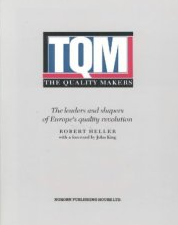
Book Review: TQM - The Quality Makers by Robert Heller

image This can hardly form a particularly useful book review since "TQM - The Quality Makers" now resides in the 'out of print' category, but dedicated hunters of quality books can find 2nd hand copies. So the question becomes - should you bother?

[amazon.com][amazon.co.uk]


Friday, 15 February 2008

Notes while reviewing: The Responsibility Virus

I got quite a lot out of reviewing the Responsibility Virus, but most of it not from the book. I recommend 2 papers from Roger Martin's web page :

  1. Breaking the code of change
  2. Strategic Choice Structuring

Taken together, these two papers provide a complementary view of the information in The Responsibility Virus.


Wednesday, 13 February 2008

Book Review: The Responsibility Virus

image
Roger Martin describes the Responsibility Virus manifesting as all-or-nothing thinking when it comes to leadership and responsibility. So when a problem manifests, if the leader succumbs to the effects of the Virus then they dive in and become the "Hero" taking all the responsibility for the problem. At which point, everyone else involved in the system infected with the Virus says "go on then" and steps back.

Thursday, 17 January 2008

Secrets to increased productivity revealed

I confess. I owned too many books on productivity - looking for a silver bullet to increased efficiency. I went through all my productivity books and threw out all those filled with platitudes and wibble wobble and ended up with 1 book. Getting Things Done. And now you can learn the secrets from Dave Allen's Getting Things Done by watching 2 Google Talks.

Getting Things Done by Dave Allen [amazon.co.uk][amazon.com]

Dave Allen's book describes a system for increasing productivity by getting you to actually do stuff. And by doing stuff you free your mind to give you time to think about new stuff.

I watched 2 Google talks:

  1. Dave Allen's Google Tech Talk on Getting Things Done

  2. Merlin Mann's Inbox Zero

Merlin Mann based his talk on Dave Allen's work so I put Dave Allen's talk in the list first. But since I watched Merlin's talk first, I'll discuss that first.

Merlin discusses his system for keeping his inbox clean by having 5 actions that he does on his e-mail:

  1. Delete (Archive)

  2. Delegate (Tickler for Follow Up)

  3. Respond (keep the ball moving - if you don't have enough info to respond effectively - ask a question)

  4. Defer (Respond Later Folder - whittle down during the week)

  5. Do It (or capture an action for later)

During the talk Merlin mentions the following points that I noted down:

  • Inbox is for mail you haven't read next

  • Keep a separate list for tasks

  • Figure the system out for yourself

Both Dave and Merlin make, and stress, the point about figuring out the system for yourself. Identify the tools and approach that works best for you. And you can only do that by implementing and experimenting with the system.

I use my email system to help me track my tasks - although I don't use my inbox - I create a folder called "Next Actions" and have a subfolder under that named <the action I want to do> and any emails relevant for that action I store in that folder. This gets the emails out of my inbox and I can archive them once I complete the action.

I don't rely on my subfolder system to 'remind' me when to do that next action so I create calendar entries which relate to the Next Actions to help me schedule them.

I have read the GTD book twice but I learned a few additional things, from the video, that didn't sink in when I read the book, and these relate to the order of doing the tasks in the GTD system.

Dave Allen's System has the notion of Control and Perspective. When planning I tend to look at the Perspective items first but Dave Allen recommends getting Control of the things currently going on first, and then dealing with perspective. When you want the video this will become clear.

The above point also relates to the different levels of view point that Dave Allen mentions:

  • 50,000 - purpose, principles

  • 40,000 vision

  • 30,000 goals (12-18 months)

  • 20,000 areas of focus/responsibility (maintenance)

  • 10,000 projects (30 - 100)

  • Runway - next actions
I, again, have a tendency to focus on my 'Vision' and 'Goals' but Dave recommends going bottom up.

Once you have watched the videos. Browse the Dave Allen site and check out the 43folders.com site.